English
 日本語
日本語 한국어
한국어Indusrty News
Content
- 1 Why Furniture Aluminium Profiles Outperform Traditional Materials
- 2 Understanding Aluminium Sections: Profiles, Shapes, and Slot Systems
- 3 Customizable Design: From Concept to Finished Piece
- 4 Practical Applications Across Furniture Categories
- 5 Specifying and Sourcing Furniture Aluminium Profiles: What Buyers Need to Know
Why Furniture Aluminium Profiles Outperform Traditional Materials
Solid wood warps under humidity fluctuations. Steel adds unnecessary weight and corrodes without protective coatings. MDF deteriorates when exposed to moisture. Furniture aluminium profiles address all three of these failure modes in a single material choice. Manufactured through the extrusion process, these profiles combine structural integrity with a mass roughly one-third that of steel, making them genuinely practical for flat-pack furniture systems, modular office installations, and retail display frameworks that require repeated assembly and disassembly.
The corrosion resistance of aluminium is not a surface treatment — it is inherent to the material. When aluminium oxidizes, the resulting aluminium oxide layer bonds tightly to the surface and acts as a self-sealing barrier against further degradation. This means furniture aluminium profiles installed in coastal environments, commercial kitchens, or humid basements maintain their dimensional stability and surface appearance without the annual re-coating that steel or iron frameworks demand. Over a ten-year period, this passive protection translates into measurable savings on maintenance labor and material costs.
Load-bearing performance is another area where aluminium sections demonstrate clear advantages. A standard 40×40 mm T-slot aluminium profile can support static vertical loads exceeding 500 kg when properly connected, making it more than adequate for shelving systems, workbench frames, and cabinet carcasses that see heavy daily use. The key is in the alloy selection and temper designation — most furniture-grade profiles use 6063-T5 or 6061-T6 alloys, which balance machinability with tensile strengths of 145–310 MPa depending on specification.
Understanding Aluminium Sections: Profiles, Shapes, and Slot Systems
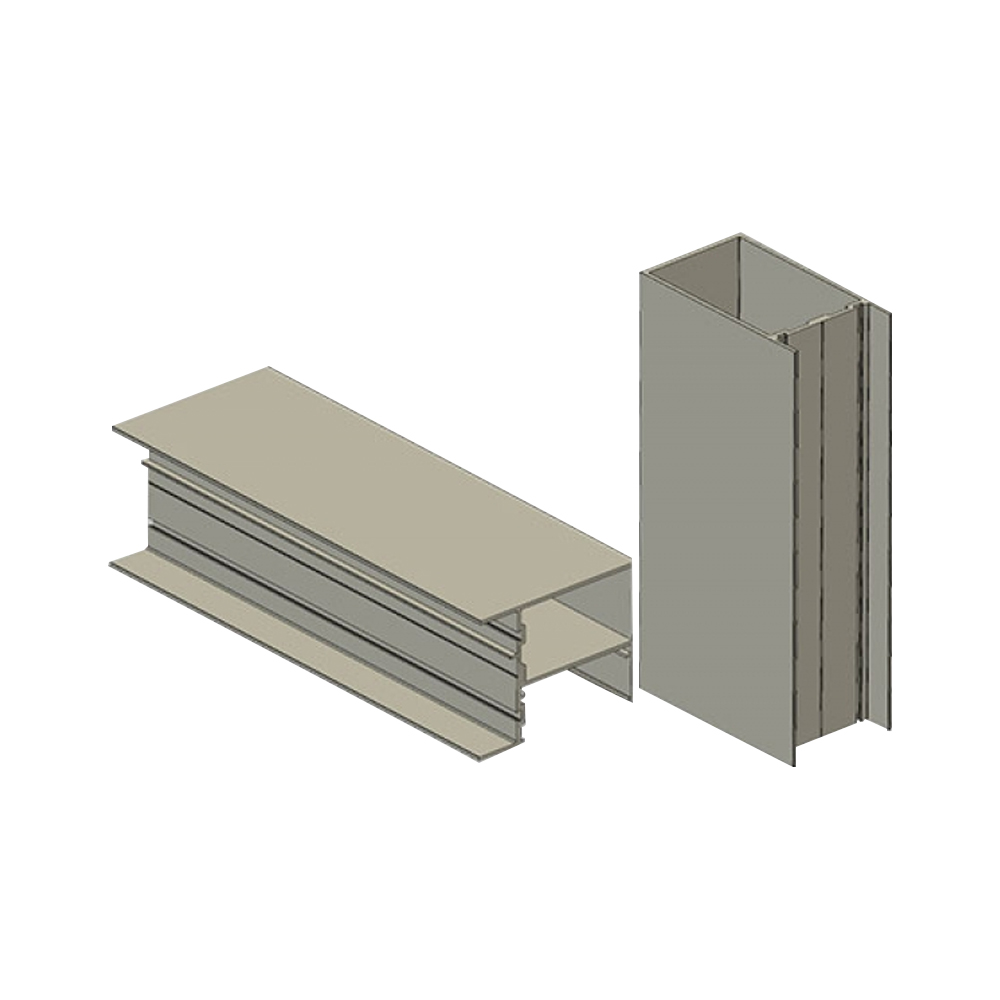
The term aluminium sections covers a broad family of extruded shapes, each optimized for a specific structural or aesthetic function. In furniture applications, the most commonly used section families include T-slot (also called V-slot or 80/20-style), closed rectangular hollow sections, angle sections, and channel sections. Each has a distinct connection logic and load transfer behavior, and selecting the right section type at the design stage avoids costly modifications during fabrication.
T-Slot Profiles
T-slot aluminium sections feature continuous longitudinal grooves along one or more faces that accept T-nuts, allowing hardware — bolts, brackets, hinges, cable management clips — to be positioned anywhere along the profile's length without pre-drilling. This makes T-slot sections the preferred choice for modular furniture systems where configuration changes are anticipated, such as adjustable shelving in retail environments or reconfigurable office workstations.
Hollow Rectangular and Square Sections
Closed hollow sections offer a cleaner visual profile for furniture pieces where the structural frame is visible — furniture legs, bed frames, and table bases being the most common examples. Without exposed slots, these aluminium sections present a smooth outer surface that takes anodized or powder-coated finishes exceptionally well, producing furniture with an appearance comparable to premium brushed steel at a fraction of the weight.
Angle and Channel Sections
L-shaped angle sections and U-shaped channel sections serve primarily as connectors, edge reinforcements, and guide rails within furniture assemblies. In drawer systems, an aluminium channel section forms the runner track; in glass-panel furniture, angle sections frame and retain the glass without the need for adhesive bonding, enabling panel replacement without dismantling the entire piece.
Customizable Design: From Concept to Finished Piece
The customizable nature of furniture aluminium profiles is arguably their most commercially significant attribute. Unlike injection-molded plastic components or cast metal parts that require expensive tooling changes for each design iteration, aluminium extrusion profiles can be cut to length, drilled, milled, and CNC-routed with standard workshop equipment. This means a furniture designer can prototype a new frame geometry in hours rather than weeks, test it under real load conditions, and refine dimensions before committing to a production run.
For manufacturers operating at scale, the customizable pathway goes further. Working with an extrusion supplier to develop a proprietary die produces a cross-sectional profile unique to a specific product line — a branded furniture system with connection geometry, slot positioning, and wall thickness tailored exactly to the assembly hardware being used. Tooling costs for a custom extrusion die typically range from USD 1,500 to USD 8,000 depending on profile complexity, a one-time investment that is amortized across production volumes very quickly for mid-to-large furniture manufacturers.
Surface customization adds another dimension of design flexibility. The primary finishing options for furniture aluminium profiles are:
- Anodizing — electrochemical process that thickens the natural oxide layer, producing a hard, porous surface that accepts dyes in colors ranging from clear/silver to black, bronze, gold, and champagne. Anodized finishes are abrasion-resistant and will not peel or flake.
- Powder coating — electrostatically applied polymer powder cured at 180–200°C, available in any RAL color. Powder coating provides excellent impact resistance and is the standard finish for outdoor or high-traffic furniture applications.
- Brushed / mill finish — untreated or mechanically brushed surface, commonly used in industrial-aesthetic furniture designs where raw material character is intentional.
- Wood grain transfer — sublimation printing process that applies a realistic wood texture onto powder-coated aluminium, combining the warmth of wood aesthetics with aluminium's structural durability.
Practical Applications Across Furniture Categories
Furniture aluminium profiles now appear across virtually every furniture category, from residential to contract and from static to fully reconfigurable. The table below maps common furniture types to the aluminium section configurations most suited to each:
| Furniture Type | Recommended Section Type | Key Functional Requirement |
|---|---|---|
| Modular shelving systems | T-slot profiles (40×40 or 40×80 mm) | Height-adjustable brackets without drilling |
| Office desks and workstations | Rectangular hollow sections + T-slot uprights | Cable management, height adjustment |
| Wardrobe and cabinet frames | Channel and angle sections | Door track, panel retention, corner jointing |
| Bed frames | Closed square hollow sections | High static load, clean visual lines |
| Retail display fixtures | T-slot profiles with custom accessories | Rapid reconfiguration between product ranges |
| Outdoor furniture | Powder-coated hollow sections | UV and weather resistance, lightweight |
The integration of aluminium sections with other materials extends the design range further. Glass panels seated in aluminium channel sections create office partitions and display cabinets with contemporary transparency. Timber panels bonded or mechanically fastened to aluminium frames combine thermal warmth with structural precision — a hybrid increasingly popular in high-end residential furniture and hospitality interiors where both aesthetics and durability are non-negotiable.
Specifying and Sourcing Furniture Aluminium Profiles: What Buyers Need to Know
Sourcing the right furniture aluminium profiles requires more than selecting a cross-section from a catalog. Buyers — whether furniture manufacturers, fit-out contractors, or procurement managers for retail chains — need to evaluate suppliers against a set of technical and logistical criteria that directly affect project outcomes.
Alloy and temper specification should be confirmed before ordering. The most common furniture-grade alloys are 6063 (preferred for complex cross-sections and superior surface finish) and 6061 (higher strength, better for structural frames under heavy load). The temper designation — T5 for press-quenched and artificially aged, T6 for solution heat-treated and peak-aged — determines the final mechanical properties and should be matched to the structural demands of the furniture being built.
Tolerance and straightness requirements matter more in furniture than in general construction. A warped upright in a modular shelving system creates assembly problems across every horizontal shelf connection. Reputable suppliers of aluminium sections hold straightness tolerances to within 0.5 mm per meter and cross-sectional dimensional tolerances within ±0.1 mm — specifications that should be requested in writing and verified against delivered samples before full production orders are placed.
For customizable furniture systems intended for export or contract supply, buyers should also confirm that the supplier's finishing processes carry relevant certifications. Anodizing quality in furniture applications is assessed per ISO 7599 (anodic oxidation coatings) and QUALICOAT or GSB standards for powder coating. These certifications provide assurance that color consistency, coating thickness, and adhesion performance will meet specification across production batches — critical when supplying branded furniture systems to multiple retail locations or hospitality groups simultaneously.
Finally, lead time and cut-to-length service capability should be assessed. Many aluminium section suppliers offer value-added processing — precision cutting, punching, and end-milling — that reduces the machining burden on the furniture manufacturer's own floor. For businesses scaling from prototype to production, a supplier capable of delivering fully machined and finished profiles in 2–4 week lead times provides a significant competitive advantage over one supplying raw stock that requires extensive in-house processing before it can enter the assembly line.