English
 日本語
日本語 한국어
한국어
Home / Blog / Indusrty News / Lightweight Aluminium Scaffolding for Construction: Assembly, Load Capacity and Safety
Indusrty News
Content
A standard steel scaffold tube weighs roughly three times more than an equivalent aluminium tube. That difference doesn't sound dramatic until you're watching a six-person crew spend forty minutes repositioning a steel scaffold bay that two workers could have moved in ten. Multiply that across a typical construction schedule and you're looking at a significant, recurring drain on labour hours — for no structural reason.
The weight gap comes down to material density. Steel sits at approximately 7.85 g/cm3. Aluminium sits at 2.7 g/cm3. For scaffold profiles of identical dimensions, that ratio translates directly into handling time, transportation cost, and assembly speed on site. Aluminium scaffold profiles are around 65% lighter than their steel equivalents — not a marginal difference, but a fundamental shift in how a scaffold system behaves in practice.
For construction professionals managing tight project timelines, that shift matters. Lightweight aluminium scaffolding for construction doesn't just reduce physical effort — it compresses the setup and teardown window, allows smaller crews to work safely without mechanical lifting aids, and makes repositioning between work zones a straightforward task rather than a planned operation.
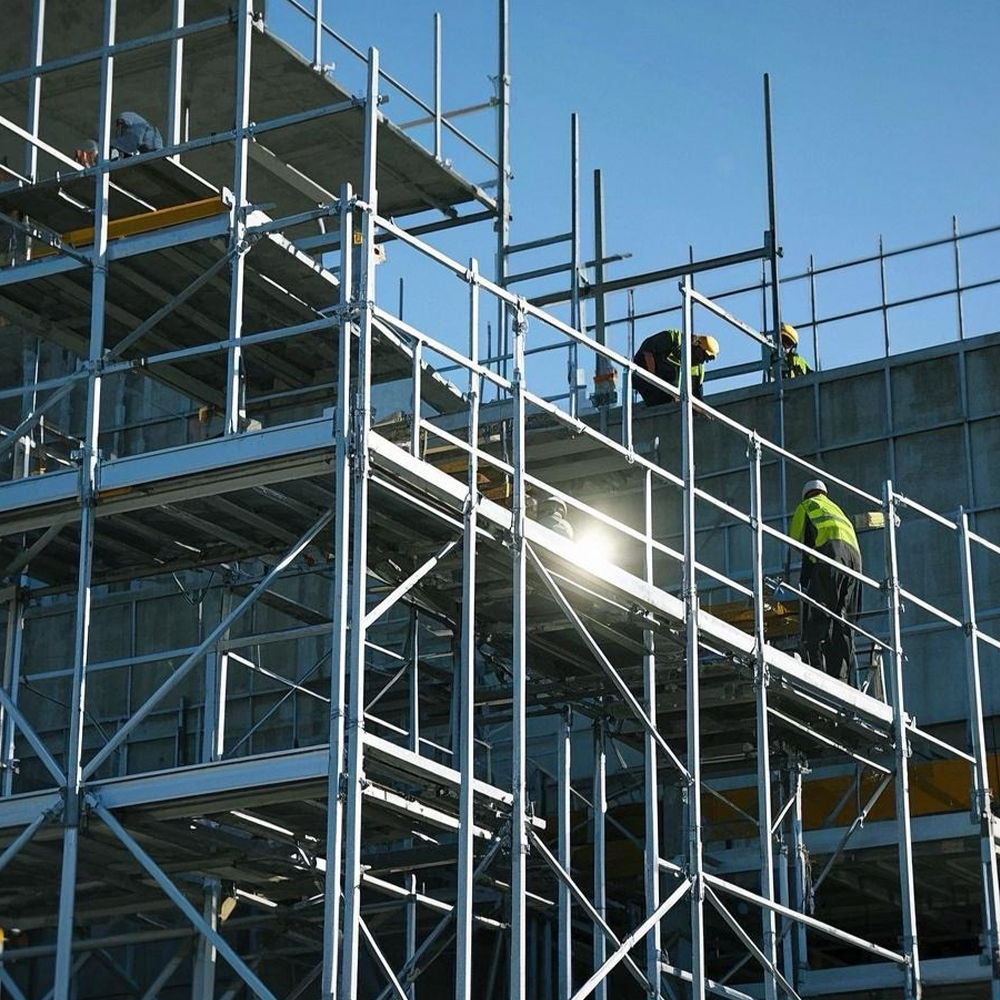
Speed and safety are usually presented as trade-offs in construction. With aluminium scaffold profiles, they reinforce each other.
Because individual components are light enough for one or two workers to handle comfortably, the assembly process becomes more deliberate. Workers aren't rushing to set down heavy components or compensating for awkward grip positions. Each section goes into place with full attention on correct connection — which is where errors that compromise structural integrity typically occur.
Modular aluminium profiles are also designed for system compatibility. Components lock or pin together in a sequence that leaves little ambiguity about correct assembly order. This matters especially on sites where the scaffold crew may include workers at different experience levels. A system that guides correct assembly through its geometry is inherently safer than one that relies entirely on operator knowledge.
The practical result: aluminium scaffold systems in construction environments are routinely set up and struck in a fraction of the time required for equivalent steel configurations. For projects that require frequent repositioning — facade work on a long building elevation, for example, or phased industrial maintenance — that speed compounds into a substantial project-level efficiency gain.
| Property | Aluminium Profile | Steel Profile |
|---|---|---|
| Density | 2.7 g/cm3 | 7.85 g/cm3 |
| Relative Weight | Approx. 65% lighter | Baseline |
| Corrosion Resistance | Excellent (no surface treatment required) | Requires coating or galvanising |
| Assembly Speed | Fast — manageable by 1-2 workers | Slower — typically requires larger crew |
| Maintenance Requirements | Low | Medium to High |
| Load-Bearing Capacity | High (heat-treated alloys) | Very High |
| Typical Application Suitability | Construction, maintenance, industrial access | Heavy civil, falsework, deep foundations |
The most common misconception about aluminium scaffolding is that lightweight means low capacity. It doesn't — provided the profiles are manufactured from the correct alloy and processed correctly.
The alloy grade is the primary determinant of load-bearing performance. Series 6000 aluminium alloys — particularly 6061 and 6082 — are the standard for structural scaffold profiles. After extrusion, these alloys undergo heat treatment (T5 or T6 temper) that raises the yield strength significantly. A well-processed 6082-T6 profile can achieve a yield strength above 250 MPa, which positions it well within the requirements for scaffold systems bearing combined personnel, tool, and material loads on active construction sites.
For context, standard scaffold platform load classes under EN 1004 range from 75 kg/m2 for light duty to 600 kg/m2 for heavy-duty industrial configurations. Aluminium profiles manufactured to the correct specification handle the full range of these load classes — the material is not the limiting factor. Profile geometry, wall thickness, and connection design are what determine the actual system capacity.
This is why sourcing matters. Industrial aluminium extrusion profiles for structural applications produced on precision-controlled lines hold tighter dimensional tolerances than those from general-purpose facilities — and in scaffold systems, dimensional consistency directly affects how components connect and how loads transfer through the structure.
Safety in aluminium scaffolding is not a feature added at the system level — it starts with the profile itself. Three material-level factors determine whether a scaffold profile will perform reliably across its service life on a construction site.
Alloy consistency. A profile labelled 6061 or 6082 should contain exactly those alloying elements in the specified proportions. Inconsistent chemistry produces profiles with unpredictable mechanical properties — sections that test fine but behave differently under sustained load or temperature variation. Reputable manufacturers maintain material certificates traceable to each production batch.
Wall thickness uniformity. The extrusion process can introduce variation in wall thickness if die design or process parameters are not tightly controlled. Thin spots in a hollow scaffold profile section create stress concentration points — locations where fatigue cracking initiates under cyclic loading. Profiles extruded on well-maintained dies with consistent process control show far less thickness variation across their cross-section.
Surface treatment. For scaffold profiles used in outdoor construction or industrial environments, surface treatment extends service life and maintains structural integrity. Anodising builds a hard, integral oxide layer that resists abrasion and corrosion without adding meaningful weight. Powder coating provides additional protection and allows colour coding for system identification. The aluminium profiles surface treatment options selected at specification stage directly affect how the scaffold performs after years of site use, transport, and storage.
Procurement teams that evaluate profiles only on price per kilogram routinely underestimate these factors — until a scaffold inspection reveals worn or deformed sections that require early replacement, eliminating any cost advantage from the original purchase.
Not all construction applications place the same demands on scaffold profiles, and specifying correctly for your use case avoids both over-engineering and under-specification.
Industrial maintenance applications — equipment access in plants, inspection of process vessels, HVAC installation in large facilities — typically involve frequent repositioning, confined space constraints, and moderate load requirements. Here, the priority is mobility and ease of reconfiguration. Lighter-section profiles with modular connection systems are appropriate, and corrosion resistance is critical in process environments where chemical exposure or humidity is a factor.
High-rise and commercial construction requires profiles that can sustain heavier platform loads over extended periods without deformation. Wider flange sections with greater wall thickness are standard, and the scaffold system is typically tied to the building structure at regular intervals to manage lateral loads from wind. Profile length and straightness tolerances matter more here — a section that is marginally bowed creates cumulative alignment issues across a multi-bay, multi-level structure.
Renovation and facade work sits between the two. Loads are moderate, but access requirements are complex — the scaffold must be adaptable to irregular building geometries. Profiles that accept adjustable couplings and can be cut and joined on site without compromising structural performance provide the necessary flexibility.
The right specification in each case starts with the profile geometry and alloy grade, not the scaffold system brand. Working with a manufacturer who can match profile cross-section and mechanical properties to your application requirements produces better outcomes than selecting from a fixed catalogue.
For buyers sourcing aluminium scaffold profiles at volume — whether for system manufacturing, project supply, or OEM assembly — the evaluation criteria that matter most are often not the ones that appear on a standard product sheet.
Jiangyin Jianbang Aluminium has manufactured precision aluminium extrusion profiles since its founding, with production lines covering architectural, industrial, and structural applications. The facility operates under ISO9001 quality management with full traceability from raw material to finished profile. For construction and industrial clients sourcing scaffold profiles at scale, Jianbang's engineering team can assist with specification review, alloy selection, and custom die development to match specific system requirements.

Copyright © 2025 Jiangyin Jianbang Aluminium Co., Ltd.
All Rights Reserved.
 Aluminum Extrusion Manufacturers
Aluminium Profile Suppliers
Aluminum Extrusion Manufacturers
Aluminium Profile Suppliers